
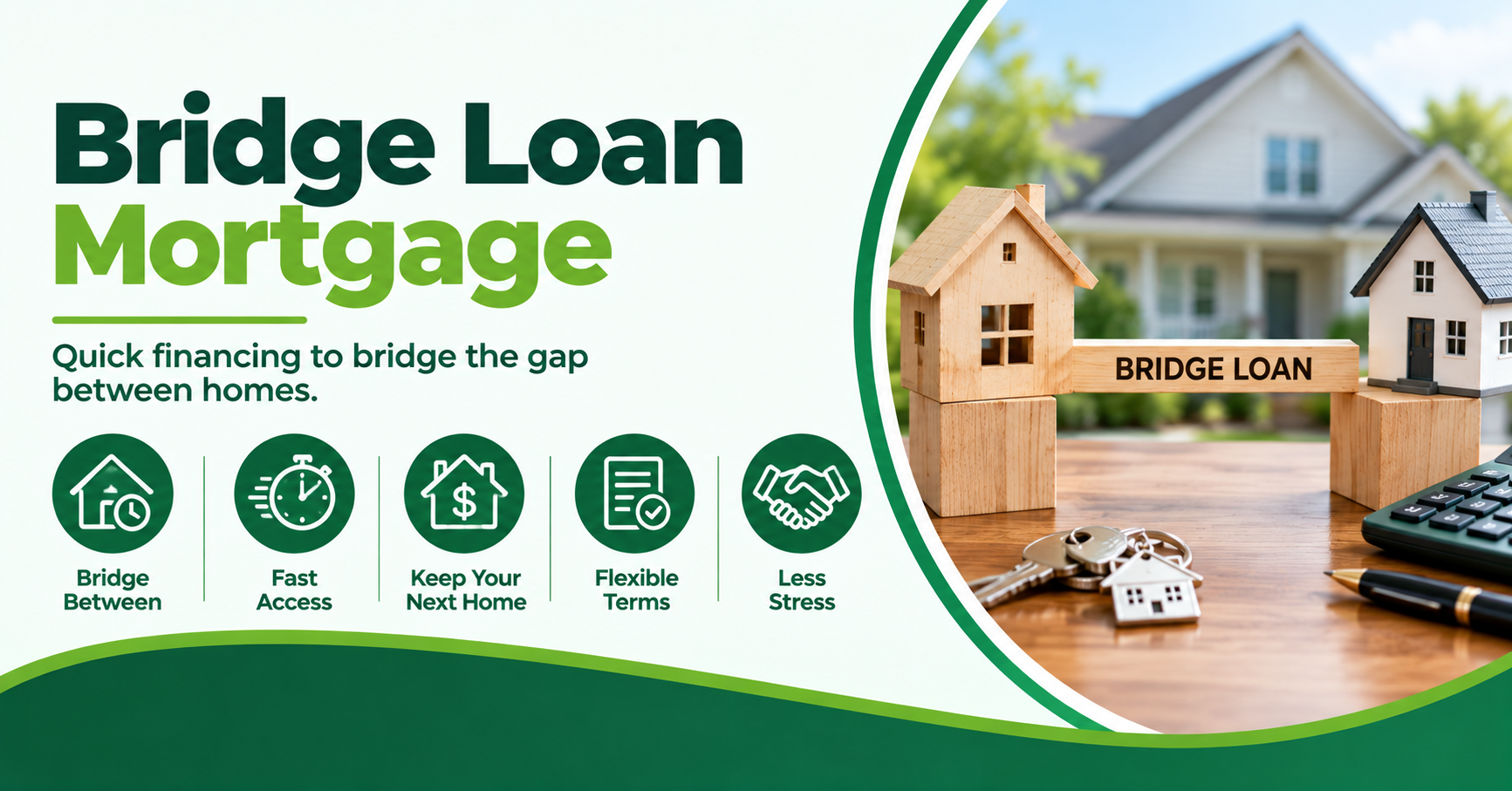
Do you love a new house but still own your old one? It’s a stressful spot. You need a down payment now, and your cash sits in a home still on the market. A brid
ge loan mortgage fills the gap for a few months.
It lets you borrow against your current home so you can buy the next one first. But it costs more than a normal loan, and it carries real risk. Below, we’ll cover how it works, what it costs, who qualifies,s and what to try first.
Table of Contents
ToggleWhat Is a Bridge Loan Mortgage?
A bridge loan mortgage is short-term financing. You borrow against the equity in your current home. You use the cash for the down payment on your next home. Then you repay the bridge when the old home sells.
Most bridge loans last six months to a year. They’re also called swing loans. Think of a bridge as a rope across a gap. It works fine, but nobody wants to stand on it for long. We tell clients the same thing. Use it fast, then get off.
What a Bridge Loan Mortgage Gives You
If you need to buy and sell at the same time, a bridge solves a few problems. Here’s what lenders and buyers like about it. Weigh each one against the price. Convenience costs money,ey and you pay for it every month.
- No Sale Contingency: You make an offer without waiting on your old home. Sellers like clean offers, especially in busy markets.
- Down Payment Cash: You tap home equity before the sale closes. A 20% down payment on the new home also skips private mortgage insurance.
- Faster Move: Approval often takes a few days. Closing takes about three weeks.
- Flexible Timing: Your closing dates don’t need to match. You move once instead of twice.
- Less Stress: You stop racing the calendar. You shop for the next home with a real offer.
How a Bridge Loan Mortgage Works
Every lender builds these a little differently. Still, most follow a simple pattern. You borrow against the old home, use the money,ney and repay when it sells. Ask each lender for its exact terms in writing. Terms differ more than buyers expect. A small fee change adds up over six months.
Two Common Structures
One version is a single large loan. It pays off your old mortgage and gives you extra cash for the down payment. The other is a second loan on your old home. Your first mortgage stays in place until the sale.
What It Costs
Rates usually run about 6% to 12%, well above a normal mortgage. Closing costs run about 1% to 5% of the loan. Say you borrow $120,000 at 9% for six months with a 2% fee. You’d pay about $7,800.
How You Repay It
Some bridge loans charge interest only, then ask for the full balance at the end. Others take interest upfront. Most expect repayment when your old home sells. Ask about prepayment penalties too, since an early sale shouldn’t cost you extra. If it doesn’t sell in time, you owe both payments.
What Lenders Check Before They Approve a Bridge
Bridge lenders are picky. They carry short-term risk and want a clear exit plan. Expect these five checks before you get a yes. Strong files get better prices. Lenders also look at your list price. An overpriced home sits,s and it raises their risk.
- Home Equity: Most lenders want about 20% equity in your current home. You usually borrow up to 80% of the combined value of both homes.
- Credit Score: A score near 700 or higher helps most. Lower scores sometimes qualify, but at higher prices.
- Debt to Income: Lenders often want your debts under 50% of income. A bridge adds a payment, so they count it.
- Steady Income: You need income to make two payments at the same time.
- Self-employed buyers need to provide additional documentation
- Exit Plan: Lenders want to know how you will sell the home.
- You can do this by signing a listing agreement and setting a price for it
Here is an example. You have a mortgage of $250,000 on a $500,000 and you want to buy a home worth $600,000 with 20% down or $120,000. A bridge loan for $120,000 to lift your old home’s debt to $370,000 would be appropriate because it is 74 percent of its value versus 80 percent for the mortgage.
Now add the overlap. Your new home adds a $3,500 monthly payment. Four extra months of overlap costs $14,000, before the bridge’s own interest and fees. Many buyers forget this math. Build a buffer for it.
Smarter Options to Try First
A bridge loan mortgage isn’t the only way to buy before you sell. Often it isn’t the cheapest. We’d compare these first, because a cheaper tool saves real money. Ask your broker to price all of them. Many buyers skip this step and regret it. A few hundred dollars of savings a month adds up fast.
Home Equity Line of Credit
A HELOC is usually cheaper than a bridge. You borrow only what you need. But most lenders won’t open one on a home already listed for sale. So you must plan ahead, before you put up the sign. Call your bank months early. Some lenders also charge a fee to close the line.
Home Equity Loan
A home equity loan is a lump sum of money that you pay back at a fixed interest rate over a long period of time. The interest for a home equity loan is often lower than that of a bridge loan, and you’ll be making payments on one home equity loan and paying off the other once the house is sold. Be sure to factor in all costs.
Contingent Offer or 80-10-10 Loan
A contingent offer says your purchase depends on selling your home. Sellers dislike it, but it costs nothing. An 80-10-10 loan uses a second mortgage and 10% down to skip PMI. Neither needs a bridge. A personal loan is a third path. It costs more than home equity, but you don’t put your house at risk.
Before you sign, ask each lender five things. What’s the rate? What are the fees? When is the balance due? Is there a prepayment penalty? Must I finance the new home with you? Get every answer in writing.
Is a Bridge Loan a Good Idea?
It depends on your home and your market. A bridge loan mortgage makes sense if your old home sells fast. You also need a high income. It’s a bad idea if your market is slow or your budget is tight. Two mortgage payments hurt fast. Run the numbers for six months of overlap first. Then add a buffer. If the old home sits for four extra months, does your budget hold? Ask yourself before you sign.
How Sai Mortgage Can Help You Buy Before You Sell
Sai Mortgage is an independent mortgage broker in Vienna, Virginia. We hold NMLS ID 179997 and serve buyers across Virginia, Washington, DC, and Maryland. We shop many lenders for one file, so a bank’s no isn’t the end of the road.
Our loans include conventional, FHA, VA, and USDA. We also do jumbo, bank statement, and DSCR loans. If you’re buying and selling at the same time, tell us your numbers. We’ll check which lenders fit, and we’ll tell you straight if a bridge costs too much.
Most pre-approvals take one to two days, and a pre-approval makes your offer stronger. Most loans close in 30 to 45 days. Our team speaks eight languages, including Urdu, Punjabi, Spanish,h and Hindi. Visit Sai Mortgage or call (703) 980-1663. Terms depend on the lender and your full file.
Conclusion
A bridge loan mortgage gets you into the next home faster. It also leaves you with two payments and a high bill. Know your exit plan ahead of time by writing out your sale price, timeline, and backup. You need to be able to price a HELOC, a contingent offer, and a bridge concurrently in order to make the least expensive choice, assuming you meet their stipulations. Questions about your own plan? Call Sai Mortgage at (703) 980-1663. We’ll talk it through in plain words.
Frequently Asked Questions:
What is a bridge loan mortgage?
A bridge loan mortgage is short-term financing against your current home. You use it for a new down payment, then repay it after the sale.
How long does a bridge loan last?
Most last six months to a year. Some lenders set a fixed repayment date. Others tie repayment to the sale of your old home.
How much does a bridge loan cost?
What is a bridge loan mortgage?
A bridge loan mortgage is short-term financing against your current home. You use it for a new down payment, then repay it after the sale.
Are bridge loans a good idea?
They help buyers with high income and a fast-selling home. They hurt buyers in slow markets or with tight budgets. Compare a HELOC and a contingent offer first.
How do I get a bridge loan?
Ask your lender or broker about bridge options. Bring proof of income, credit,t and home equity. Lenders also want your listing plan for the old home.